Lift Configuration
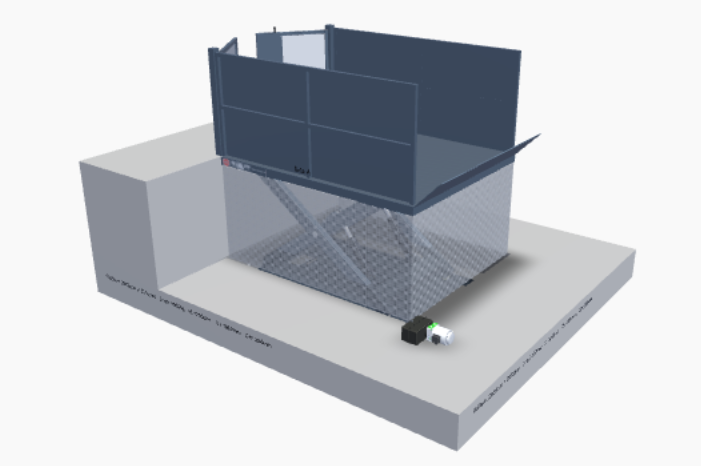
To ensure stable and reliable operation, the loading bay lift is equipped with supporting legs. A remote power unit is also installed to simplify service access and maintenance.
Assessing Travel Zone Risks
When designing a loading bay lift, it is important to evaluate potential risks in the travel zone according to EN 1570. These risks include both falling hazards and crushing hazards that may occur during lift operation.
In this scenario, the lift carries a risk of falling because the lifting height exceeds 0.5 metres and operators may stand on the platform during operation. Additional risks occur due to the open loading side used for vehicles at different heights, access from dock level, and the possibility of unauthorized people approaching the lift because it is installed in a public area.
There is also a potential crushing risk when the lift moves. The operator may have limited visibility of the travel zone when standing on the platform, and the installation next to a dock and inside a pit increases the need for protective safety measures.
Applying EN 1570 Safety Measures
To reduce these risks and ensure compliance with EN 1570-1:2024, several safety features are added to the loading bay lift.
Flexible Guarding
A steel mesh flexible guard is installed underneath the platform. This safety solution helps prevent crushing hazards for people or objects located in the travel zone below the lift.
Anti-slip Platform Surface
A checker plate surface is added to the platform to reduce the risk of slipping. Since the lift operates with personnel on the platform and the lifting height exceeds 0.5 metres, an anti-slip surface is required to ensure safe footing.
Sheeted Handrails
Sheeted handrails are installed on the sides of the platform. Because the lift is located in a public area, the handrails must be sheeted to prevent climbing and to reduce the risk of falls for both authorized and unauthorized persons.
Manual Bridge Plate
On the open loading side, a manual bridge plate is installed. This solution allows vehicles at different heights to be loaded and unloaded while preventing people from falling or goods from rolling off the platform.
Safety Gates with Interlock
On the dock side of the lift, double sheeted gates are installed. The gates are equipped with an interlock system that ensures the lift cannot move unless the gates are fully closed. The gates are mounted remotely on the dock to prevent people from falling from the dock when the lift platform is at another level.
Final Loading Bay Lift Configuration
With these safety measures applied, the loading bay lift is configured to support safe loading and unloading operations while meeting the relevant EN 1570-1:2024 safety requirements. The combination of fall protection, anti-slip surfaces, guarding, and controlled access helps create a safe working environment for operators and surrounding personnel.
Important Notice
This guide provides a simplified introduction to designing a loading bay lift using the Translyft Product Configurator. The example demonstrates how key EN 1570-1:2024 safety requirements can be applied to a specific project. Depending on your installation and working environment, additional safety measures or design considerations may be required.
We recommend contacting Translyft to discuss your project in detail so we can help you design a fully compliant lifting solution that fits your exact operational needs.