
Stairs

Stairs for Lifting Tables

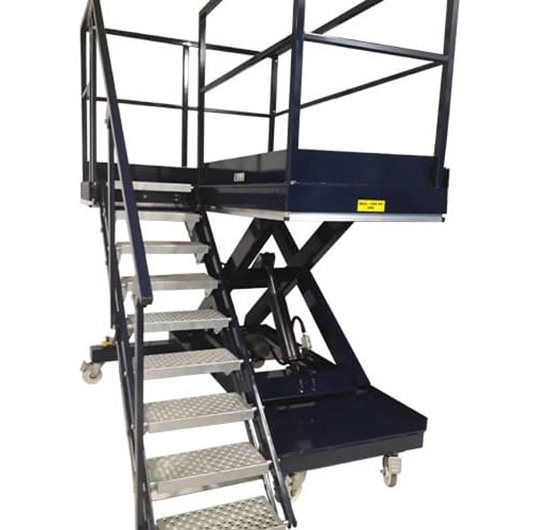
Flex stairs are a feature that is mostly used for work platforms providing safe and ergonomic access to the platform. When the work platform is used by multiple operators at the same time, they allow employees to walk on and off the platform easily, even while others continue working. This saves times as the work platform does not need to travel to closed height for a single operator to leave the platform.

The flexible stairs unfold while the lifting table lifts from the ground. The stairs usually range from a single step for smaller work platforms to 10 steps for larger work platforms, but more can be customized if needed.

The stairs are designed according to recommended step proportions, ensuring safe and comfortable use.
Technical Specification

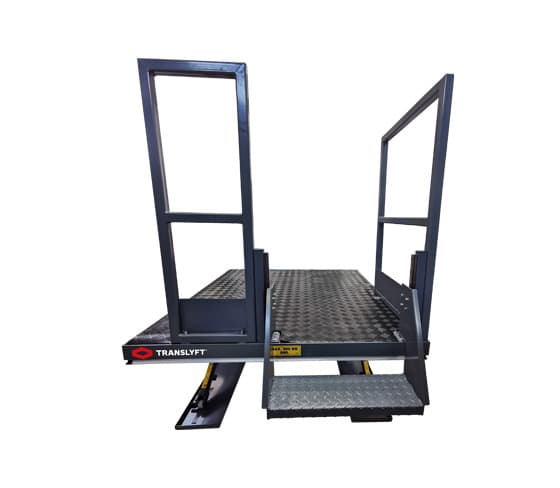
Translyft access stairs are custom designed to match the lifting table, platform height, travel range, and operating environment.

The stair systems are manufactured in galvanised steel, because they are both sturdy and resistant to environments exposed to moisture and varying weather conditions. They have a non-slip surface for constant grip and increased safety.
The steps are 800 wide and 215 mm deep. There are handrails on both sides at 1100 mm. height.

Stairs on lifting table
Different types of stairs 
  • Flex stairs
    Translyft offers a stair solution for lifting tables that is flexible. It is mounted on the lifting table and has its own wheels to adjust to the height of the lifting table. This is by far the most popular solution.
  • Fixed stairs
    For smaller work platforms we provide a small fixed stairs usually with just a few steps. Fixed stairs provide permanent access to lifting platforms. This solution offers excellent stability and is often used for smaller production workstations.
  • Custom Designed Stair Systems
    Where space constraints or special operational requirements exist, Translyft can design customised stair solutions adapted to the specific installation.
    This may include angled layouts, platform transitions, or integrated access systems combined with guardrails and safety gates.

Access stairs can be integrated with a wide range of Translyft lifting tables and lifting platforms.

Advantages of Translyft stairs

  • Improved Operator Safety
    The primary benefit of dedicated access stairs is improved safety when entering and leaving the lifting platform.
    A permanent stair solution reduces the risks associated with portable ladders and temporary access equipment.
  • Better Ergonomics
    Access stairs allow operators to move naturally between floor level and the platform.
    This reduces physical strain and improves accessibility when personnel frequently access the work area throughout the day.
  • Increased Productivity
    When operators can access the platform quickly and safely, workflow interruptions are reduced. When many people operate on the same platform the work is not delayed when one of the workers needs to get of the work platform during the work.
    This is particularly beneficial in production environments where personnel repeatedly move between the platform and surrounding workstations.
  • Compliance with Workplace Safety Requirements
    Many applications involving personnel access require safe and controlled access arrangements.
    Integrated stair systems can form part of a complete safety solution together with guardrails, safety gates, and platform protection systems.
  • Long Term Reliability
    Unlike temporary access equipment, purpose built stair systems provide a durable solution designed to withstand continuous industrial use.
  • Integration with Guardrails and Safety Gates
    Access stairs are often combined with platform guardrails and safety gates to create a complete access and fall protection solution.
  • Durability and Maintenance
    Translyft access stairs are designed for continuous industrial use and daily operator traffic.
    To maintain safe operation, stair treads, handrails, fixings, and safety gates should be inspected regularly as part of routine maintenance and annual lifting table service.
    Particular attention should be given to non-slip surfaces, handrail integrity, and any moving safety components to ensure continued safe access throughout the lifetime of the installation.
FAQ about stairs for lifting tables
  • When are access stairs required for a lifting platform?

    Access stairs are used on work platforms. They are recommended whenever operators regularly need to enter or exit the platform during operation and even at height. They provide a safer and more ergonomic alternative to ladders and temporary access solutions.

  • Can access stairs be customised for different platform heights?

    Yes. Translyft access stairs are custom designed to match the platform height, travel range, available space, and operational requirements of each installation.

  • Are non slip stair surfaces available?

    Yes. Stair treads are always supplied with non-slip surfaces to improve traction and reduce the risk of slips in industrial environments.

  • Can stairs for lifting tables be used on outdoors lifting solutions?

    Yes. Galvanised steel stair systems are particularly suitable for outdoor installations and environments exposed to moisture and changing weather conditions.

  • Can access stairs be combined with guardrails?

    Yes. Translyft access stairs come with guardrails to provide a complete safety and access solution for lifting platforms.